
What does floor insulation cost per m² in Belgium in 2026?
Last updated: April 2026
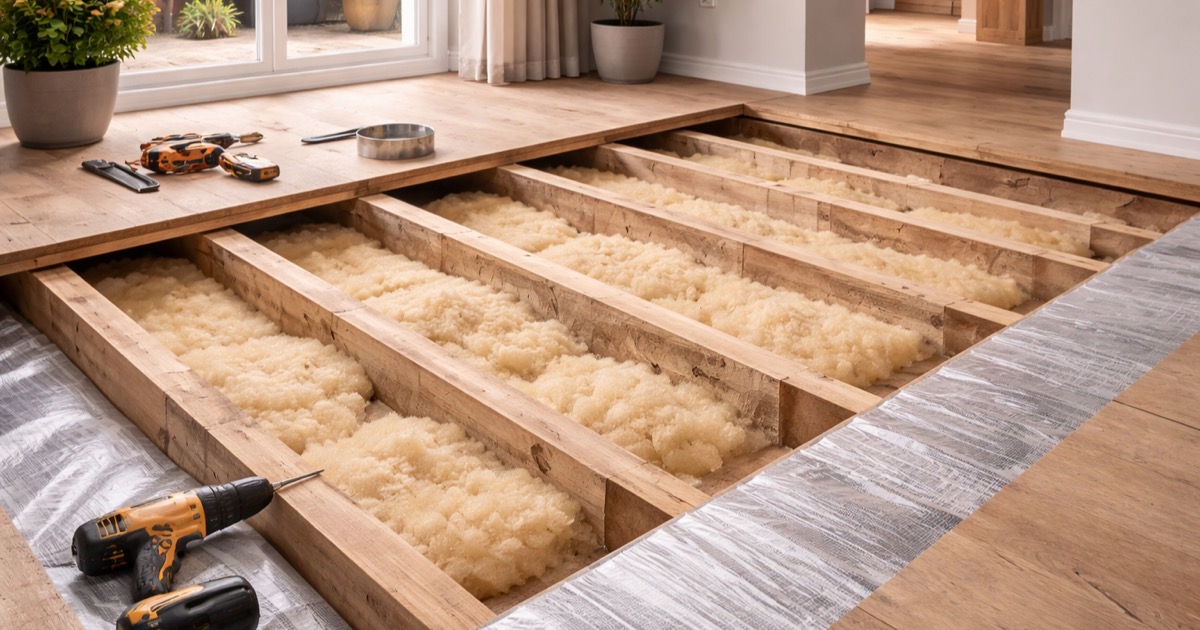
Floor insulation is an effective way to reduce heat loss through the ground floor. In an average home, approximately 10-15% of heat is lost through the floor, which shows up directly as cold feet and higher heating costs when insulation is poor or absent. Depending on the construction of the home, several methods are available: insulation in the crawl space (underfloor insulation via membrane or blown-in material), insulation of the floor from below (under the concrete slab), or insulation above the floor level using insulating screeds. The choice depends on the floor type (concrete slab or timber), the presence and height of a crawl space, and soil conditions.
The cost of floor insulation ranges from €14 to €50 per m², depending on the insulation method and material. Underfloor insulation via a membrane in the crawl space is the cheapest solution (€14-€25/m²) but insulates less effectively than PUR or PIR boards fixed to the underside of the floor (€30-€50/m²). For homes without a crawl space (on a concrete slab foundation), blown-in insulation or a completely new floor system is required. The regional renovation grants makes floor insulation particularly attractive, especially when combined with another insulation measure.
Know someone considering this project?
Share this cost guide in 5 seconds.
Calculate your estimated costs
View subsidy information
This is an estimate based on average 2026 prices. Actual costs may vary. Always request multiple quotes for an exact price.
Cost factors
The total cost usually consists of:
- Insulation material (PUR/PIR/membrane/blown-in): 40-55% of the total
- Installation labor: 30-40% of the total
- Crawl space or floor preparation: 8-15% of the total
- Fixings and finishing: 5-10% of the total
These percentages can vary depending on the insulation method, floor type, and accessibility of the crawl space.
Why do prices vary?
- Type of insulation method: Underfloor insulation via a membrane in the crawl space (€15-€25/m²) is affordable and quick to install. Fixing PUR/PIR boards to the underside of the floor (€30-€55/m²) gives a higher Rd-value. Blown-in insulation (€20-€40/m²) suits difficult-to-access spaces. Above-floor insulation requires a new screed, significantly increasing costs.
- Crawl space presence and accessibility: Homes with a well-accessible crawl space (height > 50 cm) are best suited for underfloor membrane insulation and board insulation from below. For a low or poorly accessible crawl space (< 30 cm), blown-in or above-floor insulation are the only options, which cost more.
- Floor type: timber versus concrete: Timber floors can be effectively insulated by placing insulation boards between the joists. Concrete ground-floor slabs are insulated via crawl space underfloor insulation or by laying a new floating screed on top, which requires extra height (minimum 60-80 mm).
- Surface: regional grants minimum and maximum limits: The regional renovation grants applies to a minimum surface of 20 m² and a maximum of 130 m². For homes with a ground floor smaller than 20 m² (e.g. small apartments), the regional renovation grants application for floor insulation is not eligible.
Subsidies & incentives
Floor insulation qualifies for regional renovation grants. The amount differs by method and is higher when combined with another insulation measure.
regional grants Subsidy for Floor Insulation
The subsidy amounts to:
- Floor insulation (PUR/PIR/blown-in): €5.50 per m²
- Underfloor insulation (membrane/granulate): €3.00 per m²
- When combined with another regional grants measure: Amount doubles (doubling rule)
Requirements
- Minimum surface: 20 m²
- Maximum surface: 130 m²
- Minimum Rd-value: 3.5 m²K/W (floor insulation) or 1.3 m²K/W (underfloor insulation)
- Installation by a qualified contractor
Calculation Examples
- Scenario 1: Floor insulation 80 m², alone80 m² × €5.50 = €440 subsidy
- Scenario 2: Floor insulation 80 m² + roof insulation (doubling rule)80 m² × €11 = €880 subsidy
- Scenario 3: Underfloor membrane insulation 80 m², alone80 m² × €3 = €240 subsidy
Regional price differences
Choose a city to view local prices and availability.
Is your city not listed?
View all insulation professionalsFrequently asked questions
Related cost guides
HR++ glass installation
High-performance glazing costs in Belgium in 2026. Compare HR++ and triple glazing, EPC gains, and regional grants.
Cavity wall insulation
Cavity wall insulation costs in Belgium in 2026. Includes Mijn VerbouwPremie, Primes Habitation, and region-specific con...
Roof insulation
Roof insulation costs per m² in Belgium in 2026. Includes Mijn VerbouwPremie, Walloon base grants, and the asbestos bonu...