
What does roof insulation cost per m² in Belgium in 2026?
Last updated: April 2026
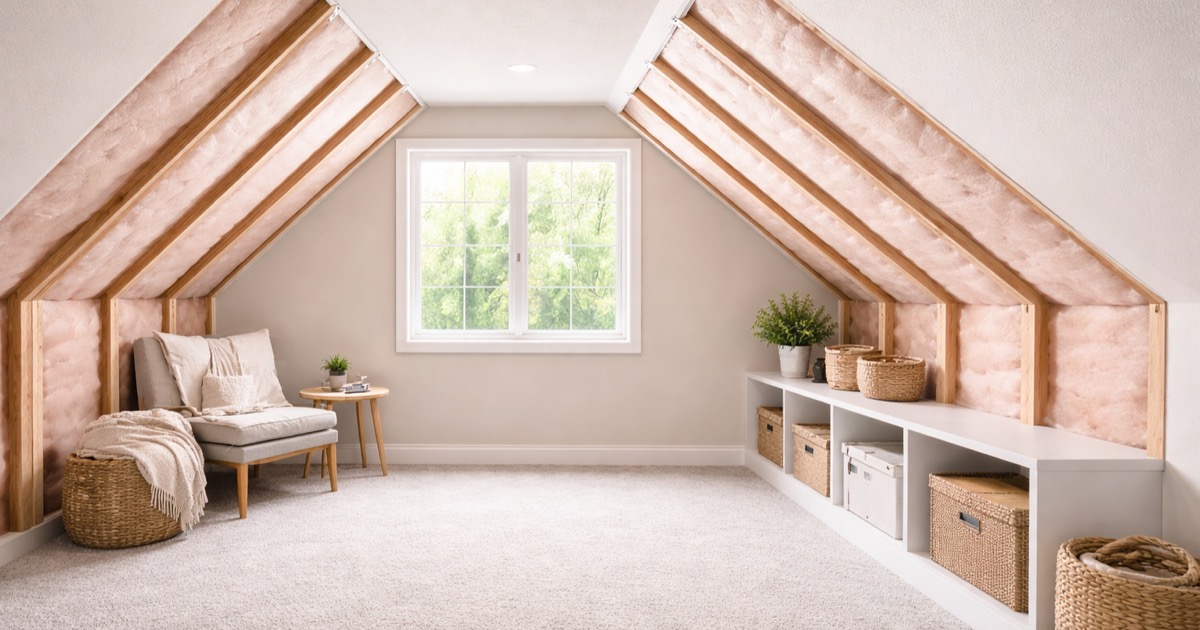
Roof insulation is one of the most cost-effective investments in making a home more sustainable. Heat rises, and through a poorly insulated roof, the average home loses 25-30% of its warmth. Good roof insulation drastically reduces this loss, lowers energy bills, and improves the indoor climate throughout the year. For pitched roofs, insulation is typically applied to the interior (between the rafters), while flat roofs are best insulated on the exterior. A higher Rc-value means better insulation; the a common high-performance renovation target in Belgium is Rc ≥ 6.0 m²K/W.
The cost of roof insulation ranges from €22 to €110 per m², depending on the roof type (pitched or flat), the insulation method (interior or exterior), and the chosen material (PUR, PIR, mineral wool, or sprayed PUR). Interior insulation of a pitched roof is generally cheaper but requires a finishing layer such as plasterboard. Exterior roof insulation (sarking) is more expensive but more effective as it eliminates thermal bridges. For flat roofs, insulation is incorporated into the roof build-up, which can logically be combined with replacement of the waterproofing membrane.
Know someone considering this project?
Share this cost guide in 5 seconds.
Calculate your estimated costs
View subsidy information
This is an estimate based on average 2026 prices. Actual costs may vary. Always request multiple quotes for an exact price.
Cost factors
The total cost usually consists of:
- Insulation material (PUR/PIR/mineral wool): 35-50% of the total
- Installation and finishing labor: 30-40% of the total
- Vapour barrier and fixings: 10-15% of the total
- Preparation and potential roofing membrane: 10-20% of the total
These percentages can vary depending on the roof type, insulation method, and the condition of the existing roof structure.
Why do prices vary?
- Interior versus exterior insulation: Interior insulation (€25-€55/m²) is cheaper but reduces headroom and requires a finishing layer. Exterior insulation (sarking, €60-€115/m²) is more effective because it eliminates thermal bridges through the rafters, but is more complex and costly as the roofing or tiles must be temporarily removed.
- Material type: PUR and PIR boards offer the highest insulation values at the least thickness (e.g. 100 mm PIR = Rd 4.5 m²K/W). Mineral wool (rock wool, glass wool) is slightly cheaper and better for acoustic comfort. Sprayed PUR seals joints perfectly but is harder to recycle.
- Pitched roof versus flat roof: Pitched roofs (tiles or slates) are typically insulated from the inside (between and below the rafters). Flat roofs are insulated from the outside as part of the roof build-up, which is logically combined with replacing the waterproofing membrane (extra cost €30-€80/m² for EPDM or bitumen).
- Accessibility and roof surface: Larger roof surfaces yield economies of scale. For steeper roofs (>30°), mandatory safety scaffolding increases labor costs. Difficult sections (dormers, chimneys) cost extra.
Subsidies & incentives
Roof insulation qualifies for regional renovation grants. The amount depends on the chosen measure and whether you combine it with other insulation measures.
regional grants Subsidy for Roof Insulation
The subsidy amounts to:
- Standard rate: €15 per m² (1 insulation measure)
- When combined with another regional grants measure: €30 per m² (doubling rule)
- Biobased bonus: Additional premium when using biobased insulation material (see the relevant regional grant portal for current amount)
Requirements
- Minimum Rc-value: 3.5 m²K/W
- Minimum surface: 10 m²
- Maximum surface: 100 m² (pitched) or 100 m² (flat roof)
- Installation by a qualified contractor
Calculation Examples
- Scenario 1: Roof insulation only (60 m²)60 m² × €15 = €900 subsidy
- Scenario 2: Roof insulation + cavity wall insulation (60 m²)60 m² × €30 = €1,800 subsidy (doubling rule)
- Scenario 3: Roof insulation + floor and cavity wall insulation (60 m²)60 m² × €30 = €1,800 subsidy for the roof + subsidy for the other measures
Regional price differences
Choose a city to view local prices and availability.
Is your city not listed?
View all insulation professionalsFrequently asked questions
Related cost guides
Cavity wall insulation
Cavity wall insulation costs in Belgium in 2026. Includes Mijn VerbouwPremie, Primes Habitation, and region-specific con...
Floor insulation
Floor insulation costs per m² in Belgium in 2026. Compare crawl space and basement ceiling insulation, plus regional gra...
HR++ glass installation
High-performance glazing costs in Belgium in 2026. Compare HR++ and triple glazing, EPC gains, and regional grants.