
What does floor insulation cost in the UK in 2026?
Last updated: April 2026
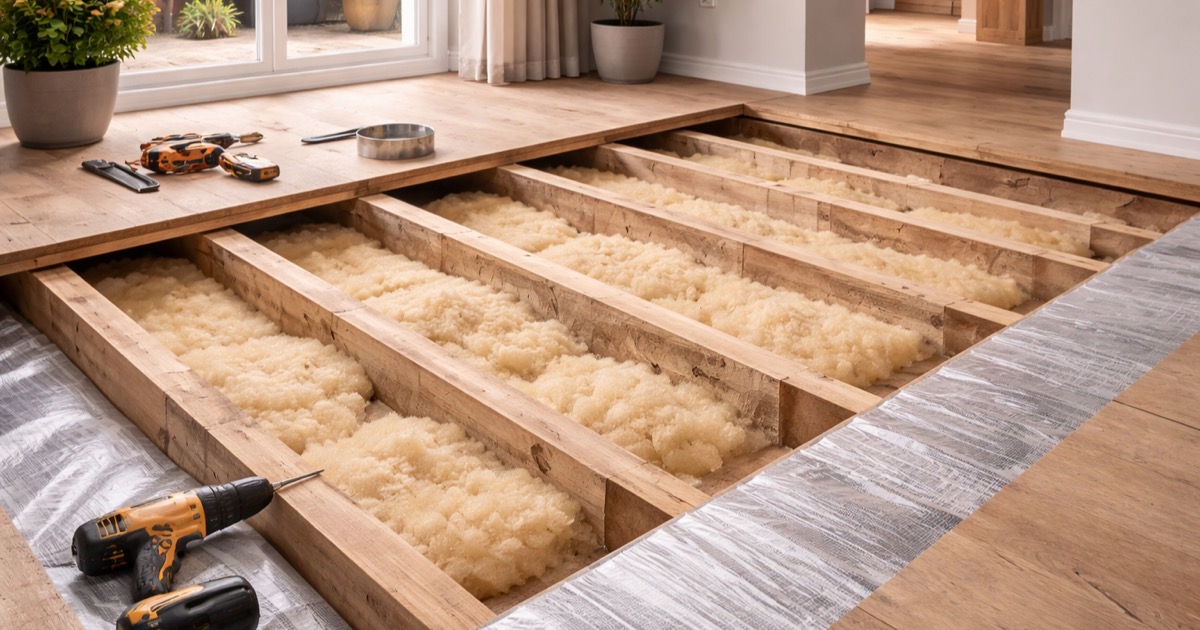
Floor insulation is often overlooked but can account for up to 15% of heat loss in older UK properties. The approach depends on your floor type — suspended timber floors (common in pre-1930s homes) can be insulated from below with rigid board or blown mineral wool, while solid concrete floors require insulation above or below the slab with rigid PIR board.
For a typical suspended timber ground floor in a semi-detached house, installation costs £500–£1,500 if accessed from below (through a crawl space) or £1,500–£3,000 if the floorboards need to be lifted. Solid concrete floor insulation costs £1,500–£4,000 depending on method and any subfloor heating integration.
Poorly insulated floors can make even well-heated rooms feel cold underfoot. Draughts through floorboards are a major source of discomfort in older UK terraced properties.
Know someone considering this project?
Share this cost guide in 5 seconds.
Calculate your estimated costs
This is an estimate based on average 2026 prices. Actual costs may vary. Always request multiple quotes for an exact price.
Cost factors
Floor insulation costs in the UK by floor type and access method.
- Suspended timber floor (blown insulation, underfloor access): £500–£1,200
- Suspended timber floor (boards lifted, rigid board): £1,500–£3,000
- Solid concrete floor (insulation boards above slab): £1,500–£4,000
- Draught-proofing floorboards only: £200–£600
- Floor insulation + underfloor heating combination: £2,500–£6,000
Energy savings from floor insulation are typically £60–£100 per year for a semi-detached house — modest compared to loft insulation, but it also improves comfort significantly.
Why do prices vary?
- Floor type: Suspended timber floors (pre-1930 homes) are often cheaper to insulate than solid concrete floors, provided underfloor access exists.
- Underfloor access: A crawl space with sufficient clearance allows blown insulation without lifting boards. Many UK homes have limited crawl space, requiring board removal.
- Draught level: Older suspended floors often have significant draughts through gaps between boards. Draught-proofing alone (sealant or insulating strips) is a cheap first step.
- Moisture control: Suspended floors need adequate subfloor ventilation to prevent moisture build-up. Blocking vents to reduce draughts can cause rot — a proper installation maintains or improves ventilation.
- Finish floor level: Adding insulation above a solid slab raises the floor level by 50–100 mm, requiring door trimming and threshold adjustments.
Subsidies & incentives
Floor insulation qualifies for 0% VAT as an Energy Saving Material. ECO4 funding may cover floor insulation for eligible households in certain circumstances — contact your energy supplier. The Warm Homes Local Grant (England) and Home Energy Scotland grant and loan scheme may also contribute to floor insulation costs as part of a whole-house retrofit. Scotland, Wales, and Northern Ireland have their own energy efficiency schemes worth checking.
Regional price differences
Choose a city to view local prices and availability.
Is your city not listed?
View all insulation professionalsFrequently asked questions
Related cost guides
HR++ glass installation
Double glazing costs £400–£1,200 per window in the UK. A full house replacement typically costs £5,000–£15,000. Find out...
Cavity wall insulation
Cavity wall insulation in the UK costs £700–£2,500 but may be free through ECO4. Find out if your home has cavity walls...
Roof insulation
Loft insulation costs £300–£1,000 in the UK, but may be free through ECO4 or the Great British Insulation Scheme. Find o...