
Underfloor heating installation in Reading
Prices are valid for 2026 and are indicative
Here you can see what underfloor heating installation in Reading costs on average. We explain what the price consists of and which local factors have the biggest impact.
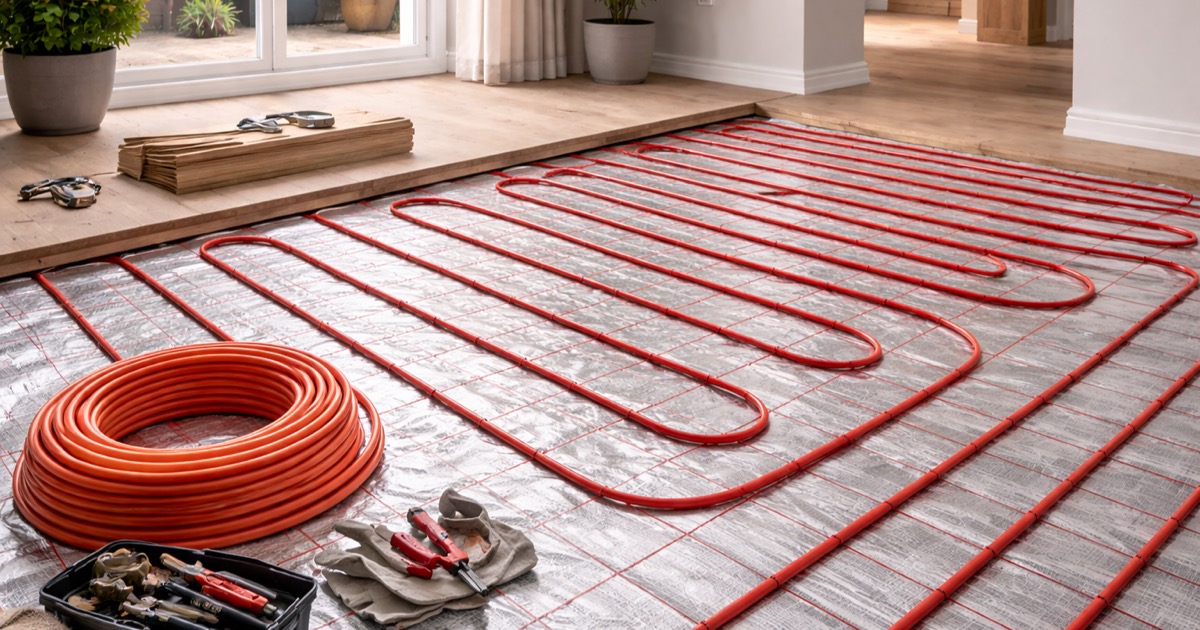
Wet UFH systems are more efficient for whole-home heating and work exceptionally well with heat pumps due to their low flow temperatures. Electric systems are cheaper to install but more expensive to run, making them better suited to bathrooms and small areas.
Costs per m² range from £20–£80 for electric systems and £50–£180 for wet systems, including materials and labour. Retrofit systems (installed over an existing floor) are more practical in renovations but add floor height — typically 10–15 mm for electric and 50–100 mm for wet screed systems.
Know someone in Reading considering this project?
Share this local price indication in 5 seconds.
Local price
£50 - £180
Average price
Average response time
-
No response time known yet
Calculate your estimated costs
≈ 40 m² based on average room size
This is an estimate based on average 2026 prices. Actual costs may vary. Always request multiple quotes for an exact price.
Cost factors
Underfloor heating costs in the UK depend on system type (wet or electric) and whether it's a new build or retrofit.
- Electric mat system (supply and install): £20–£60 per m²
- Electric cable system (supply and install): £25–£80 per m²
- Wet (hydronic) system – new build: £50–£100 per m²
- Wet (hydronic) system – retrofit: £80–£180 per m²
- Manifold and controls (wet system): £400–£1,200
- Smart thermostat per zone: £80–£200
Electric systems qualify for 0% VAT on supply. Wet systems connected to a heat pump also benefit from 0% VAT. A 10-bedroom house (100 m²) typically costs £8,000–£15,000 for a wet system retrofit.
Why do prices vary?
- System type: Wet systems have higher installation costs but lower running costs. Electric systems are cheaper to install but cost 3–4x more to run per kWh.
- Floor finish: Tiles and stone conduct heat best. Engineered wood works well. Solid wood and thick carpet reduce efficiency. Check the system's maximum floor temperature before choosing a finish.
- New build vs retrofit: Retrofit wet systems require breaking up existing floors or using low-profile systems that raise floor level by 15–30 mm.
- Number of zones: Each heating zone needs its own thermostat and manifold connection. More zones improve control but add cost.
- Insulation below: Proper insulation boards beneath the pipes are essential — without them, heat is lost downward, reducing efficiency and increasing bills.
- Screed vs dry system: Traditional screed wet systems take 4–6 weeks to cure before use. Dry systems (clip rails, aluminium spreader plates) can be walked on within days.
Subsidies & incentives
Electric underfloor heating benefits from 0% VAT under the Energy Saving Materials relief. Wet UFH systems connected to a heat pump also qualify for 0% VAT. If combined with a heat pump installation, the Boiler Upgrade Scheme (BUS) grant of £7,500 applies to the heat pump element. No standalone UFH grant currently exists in the UK.
Local considerations in Reading
Average (baseline)Thames Valley commuter town with above-average household incomes and London-influenced trade rates.
Housing characteristics in Reading
Reading is one of England's most economically dynamic towns, located at the heart of the Thames Valley technology corridor (known as the UK's Silicon Valley), with major employers including Microsoft UK, Oracle, and Vodafone headquartered locally. The housing market is strongly influenced by London commuters — a 25-minute train journey to Paddington puts Reading within easy reach of the capital while offering significantly more affordable property. Victorian terraces in the town centre (Caversham, Tilehurst) sit alongside extensive suburban development from the 1960s through to the 1990s. Reading's suburban housing stock includes large volumes of 1960s–80s detached and semi-detached houses built for the expanding technology workforce — many now owned by mature households undertaking significant renovation and extension projects. Trade rates in Reading reflect the Thames Valley premium — day rates are 10–20% above the national average, closer to London rates than Midlands or Northern equivalents. Household incomes are high relative to the national average, driving demand for premium specifications in kitchen and bathroom renovation, extensions, and smart home technology. The flat Berkshire landscape makes extension and groundwork projects generally straightforward.
- Strong London commuter demand drives premium specifications
- Mix of Victorian terraces and extensive 1960s–80s suburban development
- Trade rates higher than Midlands or North — influenced by London proximity
- Good road and rail access for trade logistics
- standard Building Regulations and planning requirements
- broad selection of local and regional contractors
- typical scheduling availability throughout the year
- Electric mat systems: 0% VAT when installed by a qualified electrician
- Wet systems work best with heat pumps — ideal combination for low running costs
- Screed curing time: minimum 4–6 weeks before system use
- Part P building regulations apply for electrical connections — certified electrician required
Handymen for Underfloor heating installation
Are you a professional?
Join the network and receive new requests.