
Roof insulation in London
Prices are valid for 2026 and are indicative
Here you can see what roof insulation in London costs on average. We explain what the price consists of and which local factors have the biggest impact.
For a standard accessible loft (no conversion, with existing joists accessible), insulation costs just £300–£600 installed. Spray foam or insulation for converted or non-standard lofts costs significantly more (£1,500–£5,000+).
Many homeowners qualify for free loft insulation through the ECO4 scheme or the Great British Insulation Scheme — particularly those on means-tested benefits or in lower EPC-rated properties.
Know someone in London considering this project?
Share this local price indication in 5 seconds.
Local price
£345 - £1.150
15% higher than average
Average response time
-
No response time known yet
Calculate your estimated costs
This is an estimate based on average 2026 prices. Actual costs may vary. Always request multiple quotes for an exact price.
Cost factors
Loft insulation costs in the UK depend on loft type and insulation method.
- Standard loft insulation (270 mm mineral wool): £300–£600
- Loose-fill blown insulation: £400–£800
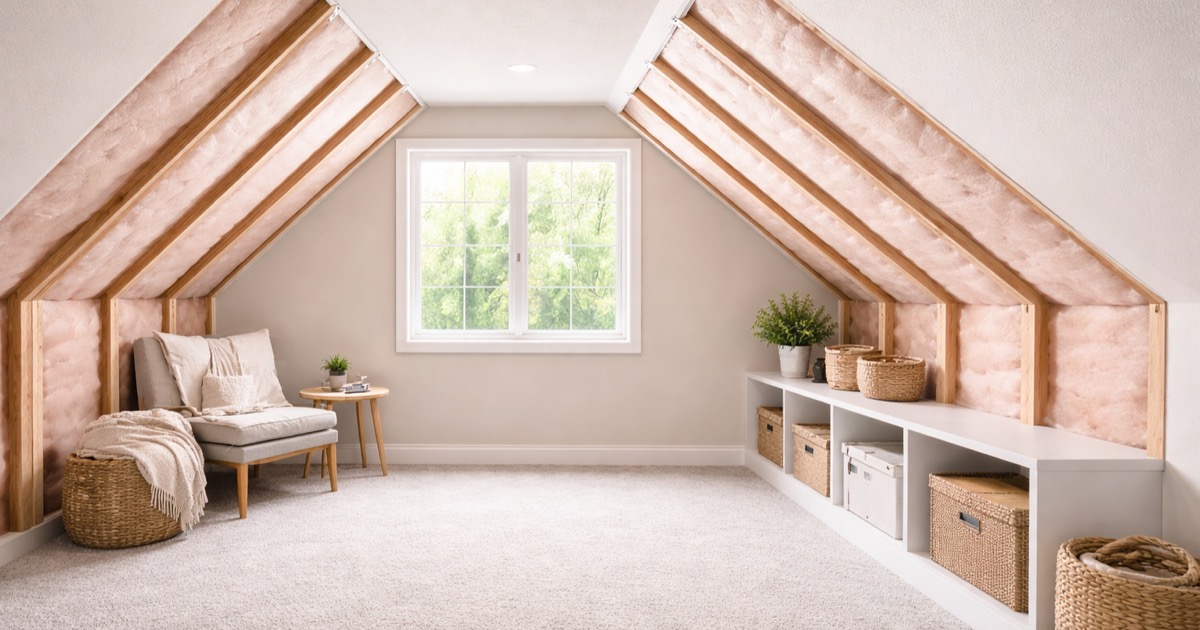
- Warm loft (insulation at rafter level): £1,500–£4,000
- Flat roof insulation (cold deck retrofit): £1,500–£5,000
- Spray foam removal (if required before sale): £2,000–£6,000
Standard loft insulation has one of the best payback periods of any home improvement — often under 3 years. Many homeowners qualify for free installation through government schemes.
Why do prices vary?
- Loft type: A standard accessible loft (unfloored) is cheapest. Boarded-over lofts require removal and replacement of boards. Converted lofts, flat roofs, and cathedral ceilings are significantly more complex and expensive.
- Existing insulation depth: Topping up from 100 mm to 270 mm costs less than starting from zero. The Energy Saving Trust recommends 270 mm minimum.
- Access and loft complexity: Tanks, pipework, and awkward angles add to labour time. A clear, accessible loft is the easiest and cheapest to insulate.
- Existing spray foam: Spray foam insulation causes major mortgage and sale problems in the UK. Removal costs £2,000–£6,000 and is required by most lenders before remortgaging.
- Scheme eligibility: ECO4 and the Great British Insulation Scheme offer free loft insulation for eligible households. Eligibility depends on income, property EPC rating, and local authority area.
Subsidies & incentives
Two main schemes offer free or subsidised loft insulation in the UK:ECO4 (Energy Company Obligation): Free insulation for households on means-tested benefits or referred by local authorities, funded by energy suppliers. Runs to March 2026.Great British Insulation Scheme (GBIS): Supports EPC D–G rated homes in lower council tax bands with one free insulation measure. Runs to March 2026.Both schemes are managed by energy suppliers — contact British Gas, Octopus, or E.ON to check eligibility. VAT is 0% on loft insulation as an Energy Saving Material.
Local considerations in London
High (+15%)Highest price level in the UK — labour costs 25–40% above the national average. Party wall agreements are standard in terraced properties.
Housing characteristics in London
London has the most diverse and expensive housing stock in the UK. Inner London is dominated by Victorian and Edwardian terraced housing — two- to four-storey houses built between 1850 and 1910, typically with solid brick walls, timber suspended ground floors, and original sash windows. These properties often have lime plaster on internal walls, requiring specialist plastering skills, and original lead pipework that may need upgrading. Many properties are divided into flats, complicating extension and loft conversion projects due to leasehold restrictions. Outer London features inter-war semis (1920s–1940s), post-war estates, and newer suburban developments. The congestion charge zone, limited parking for trade vehicles, and the sheer volume of tradespeople competing for a small number of work windows drive up both labour rates and project timelines. Most structural work in terraced properties requires a Party Wall Agreement — a legal requirement that adds £700–£2,000 per neighbour and can cause significant delays if neighbours are uncooperative. Conservation areas are widespread across inner and south west London, restricting changes to window styles, external materials, and roof alterations. Many homeowners budget 30–40% more than national estimates for equivalent projects.
- Victorian and Edwardian terraces dominate inner London
- High trade day rates due to congestion and demand
- Party wall agreements required for most structural work
- Conservation areas restrict external changes in many neighbourhoods
- highest trade day rates in the UK
- high demand — book tradespeople well in advance
- conservation area and planning restrictions common
- 0% VAT on loft insulation as energy saving material
- ECO4 and GBIS offer free installation for eligible households — check before paying
- Avoid spray foam — causes mortgage and sale issues in UK
- Recommended depth: 270 mm mineral wool
Handymen for Roof insulation
Are you a professional?
Join the network and receive new requests.