
Roof insulation in Cardiff
Prices are valid for 2026 and are indicative
Here you can see what roof insulation in Cardiff costs on average. We explain what the price consists of and which local factors have the biggest impact.
For a standard accessible loft (no conversion, with existing joists accessible), insulation costs just £300–£600 installed. Spray foam or insulation for converted or non-standard lofts costs significantly more (£1,500–£5,000+).
Many homeowners qualify for free loft insulation through the ECO4 scheme or the Great British Insulation Scheme — particularly those on means-tested benefits or in lower EPC-rated properties.
Know someone in Cardiff considering this project?
Share this local price indication in 5 seconds.
Local price
£300 - £1.000
Average price
Average response time
-
No response time known yet
Calculate your estimated costs
This is an estimate based on average 2026 prices. Actual costs may vary. Always request multiple quotes for an exact price.
Cost factors
Loft insulation costs in the UK depend on loft type and insulation method.
- Standard loft insulation (270 mm mineral wool): £300–£600
- Loose-fill blown insulation: £400–£800
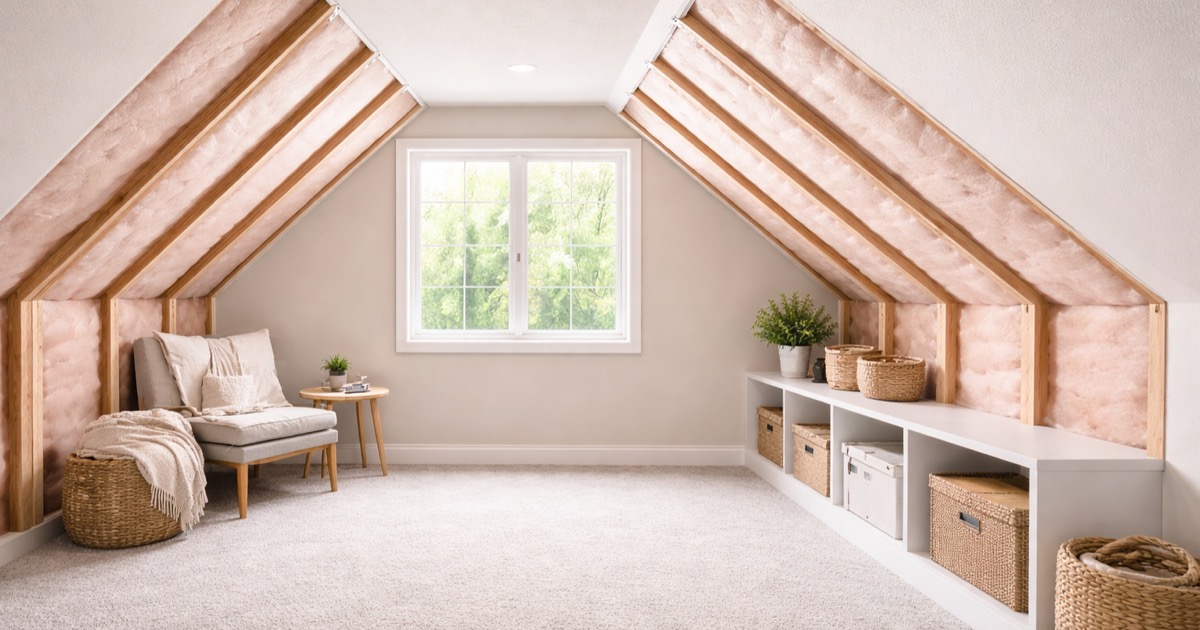
- Warm loft (insulation at rafter level): £1,500–£4,000
- Flat roof insulation (cold deck retrofit): £1,500–£5,000
- Spray foam removal (if required before sale): £2,000–£6,000
Standard loft insulation has one of the best payback periods of any home improvement — often under 3 years. Many homeowners qualify for free installation through government schemes.
Why do prices vary?
- Loft type: A standard accessible loft (unfloored) is cheapest. Boarded-over lofts require removal and replacement of boards. Converted lofts, flat roofs, and cathedral ceilings are significantly more complex and expensive.
- Existing insulation depth: Topping up from 100 mm to 270 mm costs less than starting from zero. The Energy Saving Trust recommends 270 mm minimum.
- Access and loft complexity: Tanks, pipework, and awkward angles add to labour time. A clear, accessible loft is the easiest and cheapest to insulate.
- Existing spray foam: Spray foam insulation causes major mortgage and sale problems in the UK. Removal costs £2,000–£6,000 and is required by most lenders before remortgaging.
- Scheme eligibility: ECO4 and the Great British Insulation Scheme offer free loft insulation for eligible households. Eligibility depends on income, property EPC rating, and local authority area.
Subsidies & incentives
Two main schemes offer free or subsidised loft insulation in the UK:ECO4 (Energy Company Obligation): Free insulation for households on means-tested benefits or referred by local authorities, funded by energy suppliers. Runs to March 2026.Great British Insulation Scheme (GBIS): Supports EPC D–G rated homes in lower council tax bands with one free insulation measure. Runs to March 2026.Both schemes are managed by energy suppliers — contact British Gas, Octopus, or E.ON to check eligibility. VAT is 0% on loft insulation as an Energy Saving Material.
Local considerations in Cardiff
Average (baseline)Welsh capital with its own planning rules and funding schemes. Welsh Government grants complement UK-wide schemes.
Housing characteristics in Cardiff
Cardiff is the capital and largest city of Wales, with a housing market that has grown rapidly driven by public sector employment, university expansion, and inward investment into the Cardiff Capital Region. The housing stock reflects Cardiff's development from a Victorian coal-export port city: inner suburbs like Pontcanna, Roath, and Canton contain some of Wales's finest Victorian and Edwardian terraces and semis, while the outer suburbs of Heath, Rhiwbina, and Lisvane feature the large inter-war and post-war semis popular with professional families. Cardiff Bay (the former docklands) has seen extensive commercial and residential development since the 1990s, including the National Assembly building and many waterfront apartment blocks. Planning rules in Wales differ from England: Welsh Permitted Development Rights were diverged from England following devolution, so what's permitted in England for extensions and loft conversions may not apply in Cardiff — always check with the local planning authority. The Welsh Government's Nest scheme provides free insulation measures for Welsh homeowners on lower incomes, complementing UK-wide ECO4 funding. High annual rainfall in South Wales (Cardiff receives around 1,200 mm per year) makes damp-proofing, waterproofing, and insulation particularly important. Trade rates are broadly at the national average to slightly below.
- Mix of Victorian terraces, inter-war semis, and modern development
- Welsh planning rules and permitted development rights differ from England
- Nest scheme (Wales) offers free insulation for eligible households
- High rainfall — coastal and valley exposure drives damp and insulation demand
- standard Building Regulations and planning requirements
- broad selection of local and regional contractors
- typical scheduling availability throughout the year
- 0% VAT on loft insulation as energy saving material
- ECO4 and GBIS offer free installation for eligible households — check before paying
- Avoid spray foam — causes mortgage and sale issues in UK
- Recommended depth: 270 mm mineral wool
Handymen for Roof insulation
Are you a professional?
Join the network and receive new requests.