
Home battery installation in Swansea
Prices are valid for 2026 and are indicative
Here you can see what home battery installation in Swansea costs on average. We explain what the price consists of and which local factors have the biggest impact.
The most common home battery systems in the UK include the Tesla Powerwall, GivEnergy, Growatt, and SolarEdge Energy Bank. A typical 5–10 kWh system costs £4,000–£10,000 installed. Larger systems (13–20 kWh) for bigger homes run £8,000–£15,000.
Batteries work best when paired with solar PV. Without solar, you can still benefit by charging at cheap off-peak tariff rates (e.g., Octopus Intelligent Go at 7p/kWh) and discharging during peak hours (30–35p/kWh), but payback periods are longer.
Know someone in Swansea considering this project?
Share this local price indication in 5 seconds.
Local price
£4.320 - £10.800
8% higher than average
Average response time
-
No response time known yet
Calculate your estimated costs
This is an estimate based on average 2026 prices. Actual costs may vary. Always request multiple quotes for an exact price.
Cost factors
Home battery costs in the UK vary by capacity and brand. Prices include supply and installation.
- 5–7 kWh battery system: £4,000–£7,000
- 9–10 kWh battery system: £5,500–£9,000
- 13–15 kWh battery system: £8,000–£12,000
- Hybrid inverter (if replacing existing): £1,000–£2,500
- Installation labour: £500–£1,500
- DNO notification and G99 application (larger systems): £0–£500
Prices have fallen around 20% since 2022 as battery technology matures. The 0% VAT relief on batteries installed alongside solar panels is a significant saving — equivalent to removing £800–£2,000 from the total cost.
Why do prices vary?
- Battery capacity: Most UK households use 8–12 kWh per day. A 5–7 kWh battery covers around half of average usage; a 10+ kWh battery provides near-self-sufficiency in summer.
- Solar pairing: Batteries are most cost-effective with solar panels. Without solar, payback relies solely on tariff arbitrage, which may take 15+ years.
- Inverter compatibility: AC-coupled batteries work with any existing solar setup. DC-coupled systems (better efficiency) may require a new hybrid inverter.
- Brand and warranty: Tesla Powerwall offers a 10-year warranty with performance guarantee. Budget brands may offer 5–7 years. Quality matters for a 10–15 year asset.
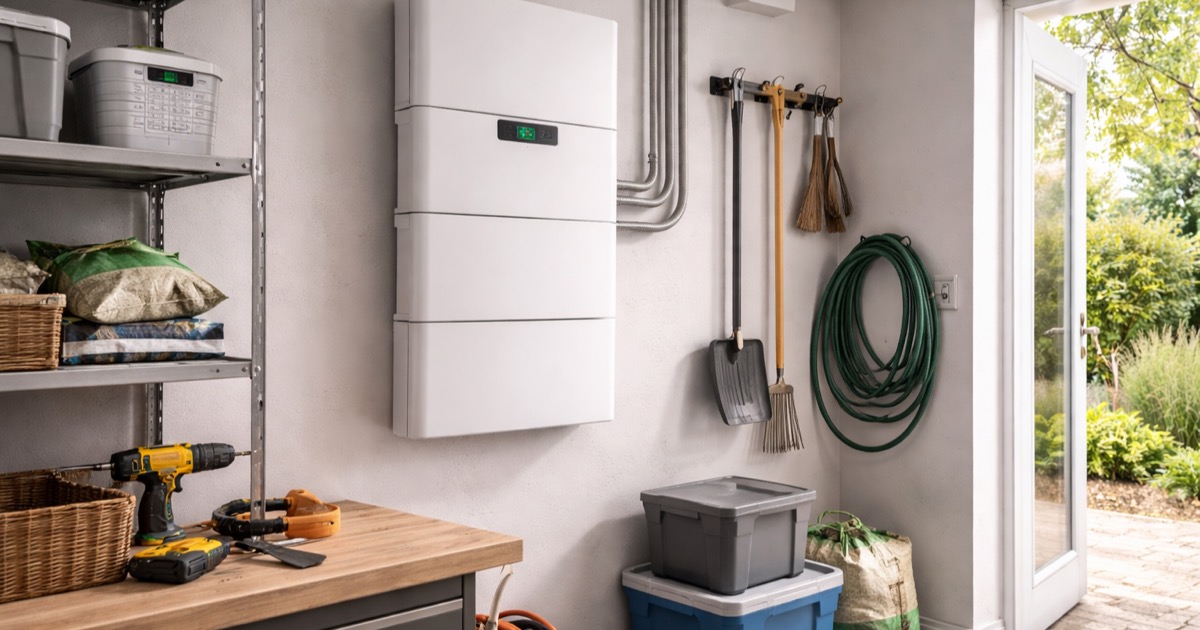
- Location and installation complexity: Outdoor-rated units (e.g., Tesla Powerwall) are mounted externally. Indoor units require a suitable space (garage, utility room) with adequate ventilation.
- Electricity tariff: Agile or time-of-use tariffs (Octopus Intelligent, OVO Beyond) are essential to maximise battery savings without solar.
Subsidies & incentives
While no standalone grant exists, 0% VAT applies to battery storage systems installed at the same time as solar panels (Energy Saving Materials relief). Batteries retrofitted to an existing solar system attract 0% VAT since February 2024. Some energy suppliers offer demand flexibility payments for discharging your battery during peak grid demand (e.g., Octopus Power-Up, National Grid Demand Flexibility Service). Low-income households may access subsidised batteries through local energy projects funded by the Warm Homes Local Grant.
Local considerations in Swansea
Above average (+8%)Coastal Welsh city with a broad housing mix and stronger weather exposure than inland markets.
Housing characteristics in Swansea
Swansea ranges from compact urban streets to exposed coastal properties and suburban areas. Seafront locations need more attention to wind, salt, and flood resilience.
- Coastal flood and wind exposure around the bay
- Urban streets plus suburban and village housing
- Planning sensitivities near the seafront and older districts
- competitive contractor market with varied pricing
- mix of period and modern housing stock
- good availability of specialist tradespeople
- 0% VAT on batteries installed with new solar panels; also applies to retrofitted batteries since Feb 2024
- G99 application required for systems above 3.68 kW export capacity — notify DNO
- MCS certification recommended for installers; required for some grant schemes
- Time-of-use tariffs (Octopus, OVO) significantly improve battery ROI without solar
Handymen for Home battery installation
Are you a professional?
Join the network and receive new requests.