
EV charger installation in Birmingham
Prices are valid for 2026 and are indicative
Here you can see what ev charger installation in Birmingham costs on average. We explain what the price consists of and which local factors have the biggest impact.
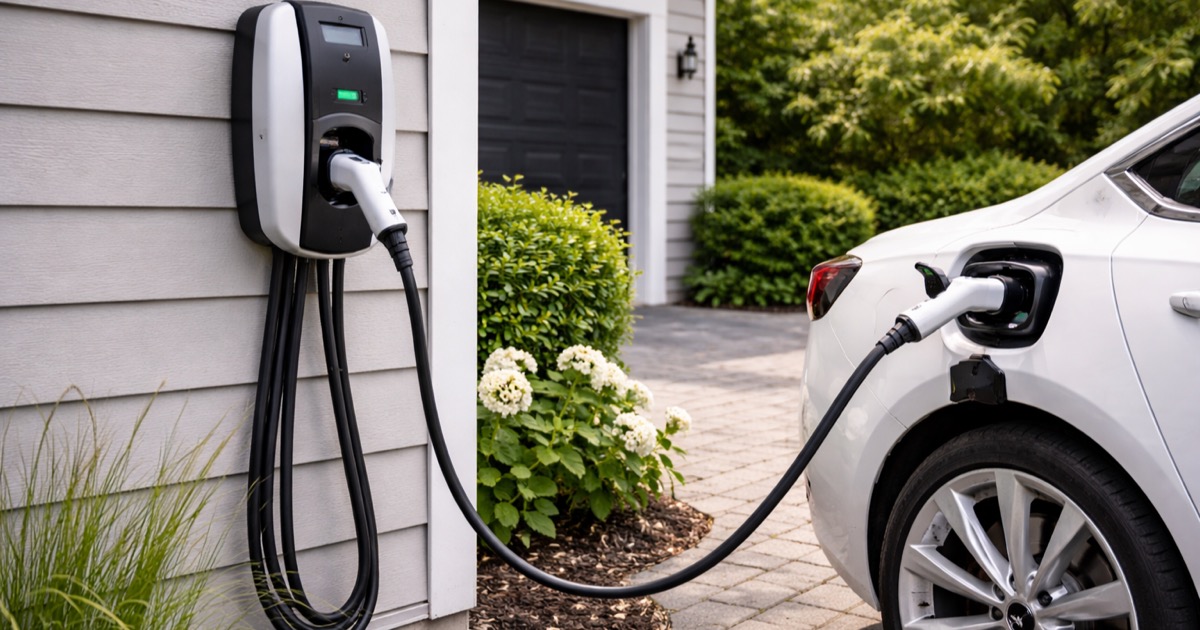
Home charger installation in the UK typically costs £700–£1,500, including the charger unit and installation by an OZEV-authorised installer. Most installations take just 2–4 hours. The cost includes a smart charger with app control, scheduled charging, and the ability to use off-peak electricity tariffs.
The UK government previously offered a £350 grant for home chargers (now closed for houses), but the EV Chargepoint Grant still provides up to £350 towards installation for flat owners and rental landlords. Many energy suppliers also offer subsidised or free charger installation as part of EV-specific tariff deals.
Know someone in Birmingham considering this project?
Share this local price indication in 5 seconds.
Local price
£700 - £1.500
Average price
Average response time
-
No response time known yet
Calculate your estimated costs
This is an estimate based on average 2026 prices. Actual costs may vary. Always request multiple quotes for an exact price.
Cost factors
EV charger installation costs in the UK depend on charger type and installation complexity.
- 7 kW smart wallbox (supply and install): £700–£1,200
- 22 kW three-phase charger (supply and install): £1,000–£2,000
- Cable run from consumer unit: £100–£400
- Consumer unit upgrade (if needed): £300–£1,000
- External trunking or underground cable: £150–£500
Most detached and semi-detached homes with a garage or driveway can be installed for £700–£1,000. Properties requiring long cable runs, consumer unit upgrades, or complex routing cost £1,200–£1,500+.
Why do prices vary?
- Distance from consumer unit: Longer cable runs require more materials and labour. A run of over 10 metres adds significantly to the cost.
- Three-phase vs single-phase supply: Most UK homes have single-phase supply, limiting charging to 7 kW. Three-phase supplies (common in some areas) allow 22 kW charging.
- Consumer unit capacity: Older consumer units may need upgrading to accommodate the new dedicated circuit. This adds £300–£1,000.
- Charger brand and features: Brands like Ohme, Zappi, and Pod Point offer smart features including solar integration, load balancing, and off-peak scheduling.
- Ground floor flat or rental: The EV Chargepoint Grant (up to £350) applies to flat owners and rental landlords — verify eligibility with your OZEV-authorised installer.
- OZEV authorisation: Installers must be OZEV-authorised to claim the government grant on your behalf. Always verify.
Subsidies & incentives
The EV Chargepoint Grant provides up to £350 (covering 75% of costs) for flat owners and rental landlords installing EV chargers. Application is managed by your OZEV-authorised installer. VAT is charged at 5% on EV charger installation for domestic properties (reduced rate). Some energy suppliers (Octopus Energy, OVO) offer free or subsidised chargers with EV-specific tariffs.
Local considerations in Birmingham
Average (baseline)UK's second-largest city — diverse housing stock and competitive trade rates. Strong demand driven by growing population.
Housing characteristics in Birmingham
Birmingham is the UK's second city and has one of the most diverse housing stocks in England. Inner Birmingham (Moseley, Balsall Heath, Kings Heath) contains Victorian and Edwardian terraces comparable to those in Manchester and Leeds, often built as artisan housing for factory workers. The inter-war period produced a huge wave of semi-detached housing across Solihull, Sutton Coldfield, and the outer suburbs — the classic 1930s British semi, with cavity walls (now suitable for insulation), bay windows, and modest rear gardens. Post-war council estates in Erdington, Chelmsley Wood, and Northfield represent a significant portion of the housing stock. Birmingham's substantial South Asian community has driven a distinctive renovation culture, with particular demand for kitchen upgrades, extensions, and multi-generational living modifications. Trade rates are competitive — typically 10–20% below London — and the large construction workforce trained through the city's apprenticeship programmes keeps labour supply strong. The Legacy Development corridor from the 2022 Commonwealth Games has catalysed significant residential investment in east Birmingham. ECO4 uptake has been high in Birmingham given the city's significant proportion of lower-income households in older, poorly insulated housing.
- Mix of Victorian terraces, inter-war and post-war semi-detached
- Competitive trade rates — good value for renovation projects
- Large proportion of 1920s–1960s semi-detached housing in outer suburbs
- City-centre regeneration driving high-spec apartment conversions
- standard Building Regulations and planning requirements
- broad selection of local and regional contractors
- typical scheduling availability throughout the year
- OZEV-authorised installer required for EV Chargepoint Grant eligibility
- 5% reduced VAT rate applies to domestic EV charger installation
- Smart charger regulations mandatory for all new UK home charger installations since 2022
- Single-phase 7 kW is standard for UK homes; three-phase 22 kW available in some areas
Handymen for EV charger installation
Are you a professional?
Join the network and receive new requests.