
Cavity wall insulation in Edinburgh
Prices are valid for 2026 and are indicative
Here you can see what cavity wall insulation in Edinburgh costs on average. We explain what the price consists of and which local factors have the biggest impact.
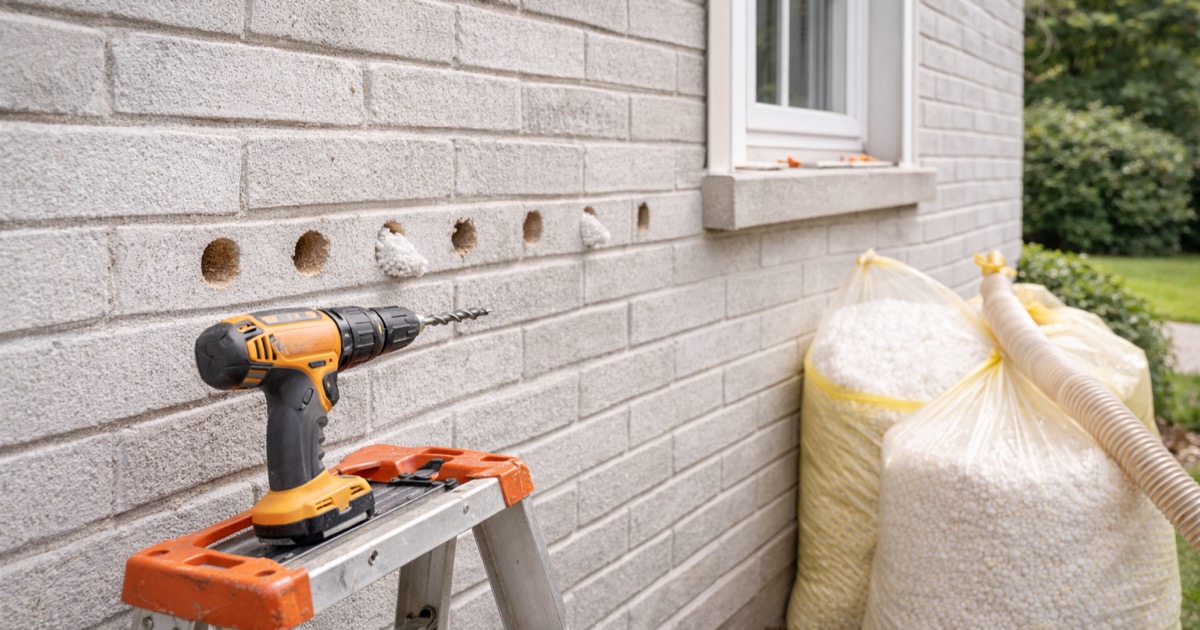
Approximately 9 million UK homes still have uninsulated cavity walls. Properly installed CWI reduces heat loss through walls by up to 35%, saving £200–£300 per year on energy bills for a typical semi-detached house.
Costs range from £700 to £2,500 depending on home size. Many homes qualify for free installation through the ECO4 scheme or the Great British Insulation Scheme. Solid wall homes (pre-1920 Victorian and Edwardian terraces) require a different, more expensive approach — internal or external wall insulation.
Know someone in Edinburgh considering this project?
Share this local price indication in 5 seconds.
Local price
£756 - £2.700
8% higher than average
Average response time
-
No response time known yet
Calculate your estimated costs
This is an estimate based on average 2026 prices. Actual costs may vary. Always request multiple quotes for an exact price.
Cost factors
Cavity wall insulation costs by property type. Many homeowners qualify for free installation through government schemes.
- Mid-terraced house (typical): £700–£1,200
- Semi-detached house (typical): £800–£1,500
- Detached house (typical): £1,200–£2,500
- Removal of failed CWI (if needed): £2,000–£5,000
- Cavity wall survey (before installation): £100–£300
Payback periods for paid-for CWI are typically 3–5 years. With ECO4 or GBIS funding, the investment pays back immediately through energy savings.
Why do prices vary?
- Wall construction type: CWI only works for cavity walls (generally post-1920 construction). Solid-wall Victorian and Edwardian properties need internal or external wall insulation, which costs significantly more.
- Cavity condition: A cavity survey checks for debris, existing partial insulation, and wall ties. Contaminated or narrow cavities may not be suitable for standard CWI.
- Property size and exposure: Larger homes and those in exposed/coastal locations require more material. Severely exposed sites may need specialist materials (e.g., foam rather than beads) to prevent moisture ingress.
- Existing moisture issues: Damp problems must be resolved before installing CWI — insulation can trap moisture and cause internal damp if the external wall has water ingress issues.
- Eligibility for free schemes: ECO4 and GBIS cover many homes free of charge. Always check eligibility before paying.
Subsidies & incentives
Two schemes offer free or subsidised cavity wall insulation:ECO4: Free for households on qualifying benefits. Funded by energy suppliers. Runs to March 2026.Great British Insulation Scheme (GBIS): Open to EPC D–G rated homes in council tax bands A–D. Runs to March 2026.VAT on cavity wall insulation is 0% as an Energy Saving Material. Scotland has additional support through Home Energy Scotland grants and loans.
Local considerations in Edinburgh
Above average (+8%)Premium pricing in the city — Scotland's most expensive market. Scottish Planning Policy and building regulations differ from England.
Housing characteristics in Edinburgh
Edinburgh is Scotland's most expensive city for home improvement, with a property market comparable in value to Bristol or Leeds. The city's extraordinary architectural heritage — the Georgian New Town (Category A listed in its entirety) and the medieval Old Town — creates significant planning and conservation challenges. Much of Edinburgh's most desirable housing consists of sandstone tenements: four- to six-storey stone buildings divided into self-contained flats (known as 'tenemental properties'). These require collective decision-making for roofing, external stonework, and close (communal stairwell) maintenance — often requiring agreement from all co-owners. Edinburgh's wet and cold climate makes insulation and heating efficiency improvements particularly valuable. The Boiler Upgrade Scheme applies in Scotland as UK-wide policy, and Home Energy Scotland offers additional grant and loan support not available in England. Scottish planning rules differ from England — Scottish Permitted Development Rights have different parameters, and Conservation Area consent is required for some changes that would be permitted in England. The festival city's popularity and growing technology sector have created very strong trade demand, with skilled tradespeople booked weeks to months in advance throughout the year.
- Category A and B listed Georgian and Victorian sandstone tenements
- Scottish building regulations differ from England — check specifics
- Tenement living means common close and shared roof repairs are collective decisions
- World Heritage Site designation covers the Old Town and New Town
- competitive contractor market with varied pricing
- mix of period and modern housing stock
- good availability of specialist tradespeople
- 0% VAT on cavity wall insulation as energy saving material
- CIGA 25-year guarantee required — only use CIGA-registered installers
- ECO4 and GBIS offer free installation — check before paying
- Cavity survey mandatory before installation — do not skip
Handymen for Cavity wall insulation
Are you a professional?
Join the network and receive new requests.